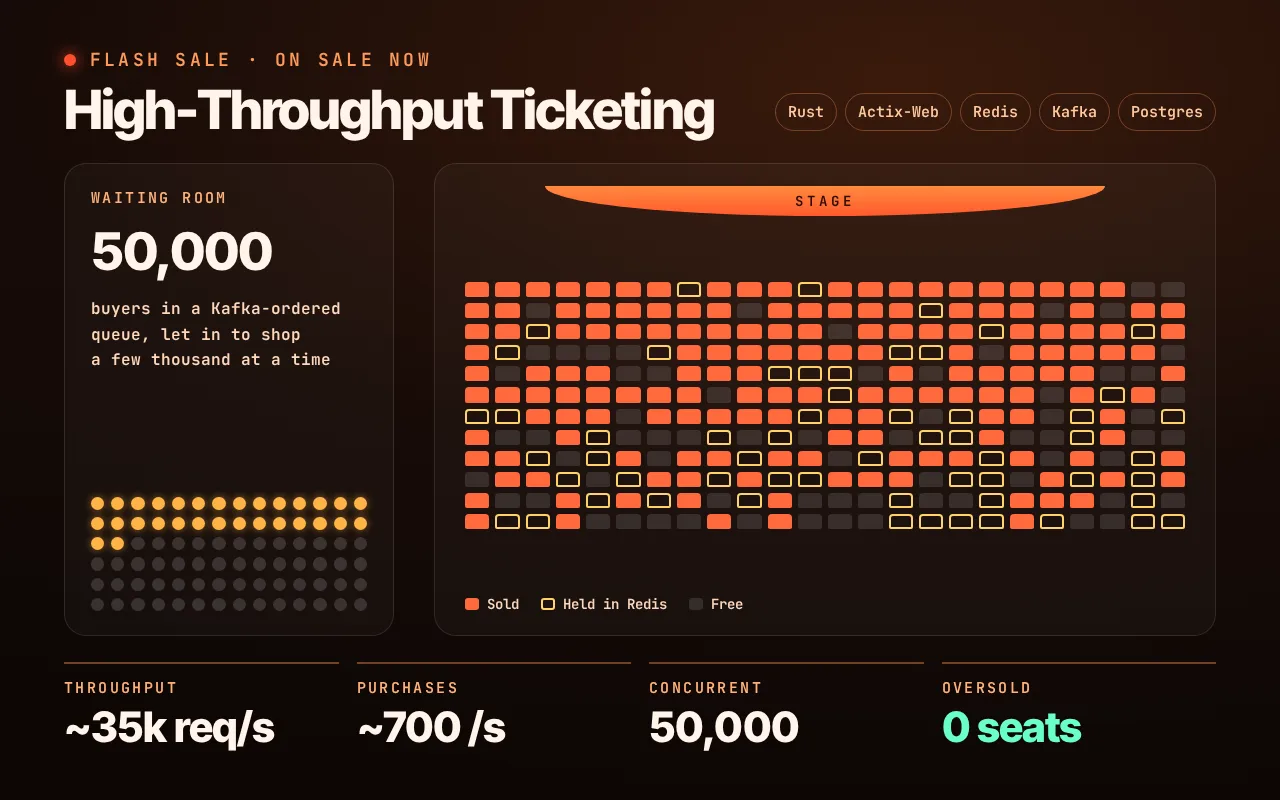
Problem
When a popular event goes on sale, tens of thousands of buyers arrive at once. The service has to stay fast, let people in fairly, and never sell the same seat twice.
How a sale works
- Join. Buyers join the event’s waiting room, a single-partition Kafka topic per event. Before the sale opens they wait in a lobby that is shuffled at opening; after that it’s first come, first served.
- Admission. A worker lets the next buyer in whenever fewer than
min(MAX_ACTIVE_TOKENS, free seats)are shopping. - Reserve. A reservation holds seats in Redis, all or none, with an atomic Lua script. It never touches PostgreSQL, because this is the busiest step.
- Pay. The payment provider reports to an inbox table in PostgreSQL. A success claims the hold at once, so a payment that arrives in time is kept however busy the payment worker is.
- Expire. A cleanup worker releases holds whose time is up.
Result
On one machine: 50,000 concurrent buyers, about 35,000 requests per second and about 700 purchases per second, with zero oversold seats. Every worker can run several copies.
Not built yet
Stripe. A fake payment provider stands in.